
The Evel Knievel Stunt Cycle is one of the most famous toys from the 1970's. Ideal Toy Company began producing the stunt cycle in 1973. The toy enjoyed unheard-of popularity until 1977 when Evel settled a score in a parking lot with a baseball bat. Ideal stopped producing Evel Knievel toys once Knievel's reputation was sullied by the incident.
Ideal sold millions of the stunt cycle sets and went on to produce other sets that included cars, other cycles, and even Knievel's famous canyon-jumping Sky Cycle (all to be featured in later posts). You can view my thoughts on the original Stunt Cycle set
HERE.
Evel Knievel toys are many people's most remembered toys from the 1970s and most everyone that was a kid in that era had at least one Evel Knievel Stunt Cycle. Because of this amazing toy's popularity and sentimental value, two separate companies have reproduced this set more recently. The first Stunt Cycle replica set was issued by Playing Mantis in 1998. It didn't use the original molds for the toy but did a great job of replicating the play experience and fun of the original. I'll cover the Playing Mantis reissue in a later post, as well.
In 2006, Ideal Toys (then recently acquired by Poof-Slinky...makers of the Slinky) began producing replicas of the original Stunt Cycle set using the original molds that were used to produce the toys in the 70s. This 2006 reissue is the subject of this post. Although different in color, the 2006 stunt cycle (at least on the outside) is a bang-on reproduction of the original. It even sports a 1972 copyright date (although it was released in 1973, I believe) on the side of the cycle. Because of this, it's important to be careful when looking for Stunt Cycles on Ebay because sellers (unknowingly...or at times, knowingly) have tried to sell the re-issue as an original. Some unwitting buyers have even payed a premium thinking the cycle they were buying was a pristine original.


I'm going to go over each of the components of the set and talk about the differences and similarities to the original 1973 toy.
CYCLE: The major difference, cosmetically, between the re-issue and the original is that the replica has been covered in a chrome paint application. The chrome makes for a striking cycle but does make it look somewhat different from the original which had a white plastic body with chrome or black tailpipes (and chrome handlebars and forks on early issues). It's easy to tell the difference if you know what to look for. It should also be noted that a front fender has also been added to the re-issue stunt cycle that was not present on the original.
The replica also includes pre-applied decals for some of the graphical accents on the cycle. The 1973 original included a sheet of small stickers to be applied to the cycle by the owner.
Mechanically, the replica reproduces most of the fun of the original. However, it does make a much louder noise when being "revved" on the energizer than the original. Although the sound is similar, it is much, much LOUDER. The replica cycle doesn't run as long as the original, either. The original's fly-wheel mechanism ran like "butter" and would seem to defy physics, at times, and continue to spin for ages. Part of this difference may be due to the replica's internal gears being made of plastic versus the metal gears of the original. The plastic gears tend to make the reissue not quite as durable as the original, as well. (Edit: It has been brought to my attention that the original cycle used plastic gears, as well. It sounds like the way the gears are installed may be making the difference...thanks, 7-inch DD) The replica runs for a decent amount of time and certainly runs long enough after release to make some
spectacular jumps and tricks. I should also mention that it's almost a hit-or-miss ordeal with the replica cycle. I had one that ran poorly until I really revved it hard and "broke it in" somehow. Another one, just ran poorly and continued to do so. Some work great right out of the box. So, just be aware that your "mileage may vary" when dealing with this re-issue of the Stunt Cycle.


 2006 replica (left) and 1973 original (right)
 2006 replica figure (left) and 1973 original (right)
FIGURE: The replica Evel Knievel figure is a very close twin to the original. Without seeing them side-by-side it can be difficult to tell them apart. The primary difference is in the application of the stars and stripes on Evel's jumpsuit. The replica uses silk-screening for the "V" with stars graphic. The original used an applique method with a stitched-on "V" with stars. Everything else is a close match. The belt is almost identical between the two. The helmet is also very close. Although, the replica is a much softer, squishier plastic than the original. They both use the same bendy-type body with hard plastic hands and feet.

ENERGIZER (winding base): Using the original molds (including a 1973 copyright on the bottom of the unit), the replica energizer is an almost exact copy of the original. The original energizer was produced in a variety of colors including red. The replica was only produced in red... which looks nice and is probably the best choice of color. The replica also sports several Evel Knievel stickers on the unit. The original 1973 set did not include stickers or graphics of any kind for the energizer. Since the replica energizer uses the original molds, vintage Evel Knievel toys can be revved on the replica and vice versa.
BOX: The box for the replica set makes no attempt to reproduce the original toy's box. The replica's box features "updated" graphics and a cellophane window to show off the toy. The
original was "blind boxed" (no windows to show the toy) like many toys of the 70s and featured some nice illustration work to show what the toy looked like. Part of me wishes that Poof-Slinky had released a more authentic version of this set using the vintage art and blind box. However, I do realize that they were most likely hoping to sell this set to kids, as well, and not necessarily always to middle-age nostalgic guys hoping to recapture a small part of their childhood.
The 2006 Poof-Slinky Evel Knievel Stunt Cycle set is a good reproduction and a fun toy. It's also a great way to reminisce and get your Evel Knievel jumping fix without spending hundreds on an original stunt cycle set that you probably would be hesitant to play with, anyway. This set, to my knowledge, is no longer being produced... although it can still be had affordably online and on auction sites like Ebay (the re-issue is starting to become more scarce, as well, but is still affordable).


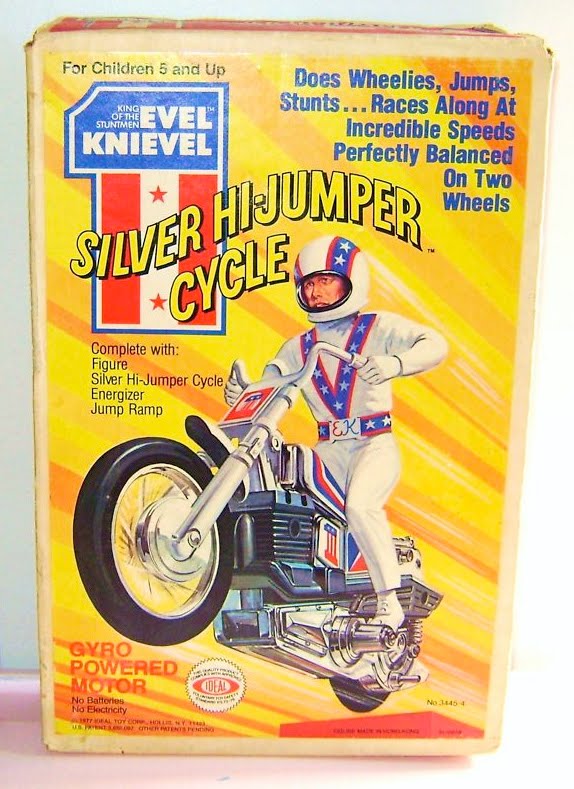
 This is the Ideal Evel Knievel Silver Hi-Jumper cycle from 1977. This is one of the most rare Evel Knievel toys ever produced. In 1977, Knievel had a controversial parking lot altercation with a writer that slandered him in a "tell-all" book. The writer left the incident with two broken arms and Evel was left facing jail time. Rather than continue to produce toys that used the Knievel name, Ideal Toys chose to end their relationship with Evel rather than risk losing money on a toy line associated with the then-maligned Knievel name.
 Consequently, some Knievel toys did not make it to production or were canceled not far into production. The Silver Hi-Jumper set was one that ended up having very low production numbers. Information online is sketchy but it seems that somewhere between 1000 and 1500 of these sets made it to toy shelves before the final curtain closed on Ideal's mighty and lucrative Evel Knievel toy line.
 The full-set included the Silver Hi-Jumper cycle, Energizer (winder), a white-suited Evel Knievel figure with helmet, and a red ramp. If I'm not mistaken, this was the only vintage Knievel cycle set to come with a jumping ramp in the box. Other sets like the Scramble Van and the Stunt Stadium (both forthcoming in reviews) included ramps but not a cycle.
 The cycle itself is actually a repaint of a much more common Knievel toy cycle called the Trail Bike. The Trail Bike body was black plastic with chromed engine and tail pipes but the Silver Hi-Jumper is painted in reverse with an all-chrome finish and black engine and tail pipes. Although, the distinction between the two bikes is somewhat minimal, the rarity of the silver bike makes it one of the line's "holy grails."
 I didn't have this cycle as a kid. In fact, I had never heard of it until more recently when researching the line of Evel Knievel toys. However, I came across this example for a screaming deal and had to pick it up. I was very glad to add it to the collection of Knievel toys I've gathered over the years.
 Every year, we make a few trips to Evel's hometown of Butte, Montana for some of my boys' soccer games. Last year, we stopped at Evel's grave to see his final resting place and pay our respects. Evel was one of my biggest heroes as a kid and it felt pretty neat to be able to walk right up and visit the grave of such a famous and iconic American.
 The backside of Knievel's grave was inscribed many years ago. Evel intended that this stone be erected as a commemoration of his attempt to jump the Snake River Canyon in 1974. When that didn't pan out, the stone was put into storage. Later in life, as Evel struggled with illness, he pulled the stone out of storage and had it transported to Butte to be used as his headstone.


