Monday, February 25, 2013

1978 Mattel Shogun Warriors Godzilla


In the 70s, cable television brought the Japanese Godzilla movies to a whole new group of young fans that hadn't had much exposure to the monster before.  I remember it always being a pretty big deal when the Denver station would run a Godzilla movie.  I didn't have cable but a friend up the street did.  So, I got to watch a bit of Godzilla here and there at his house.  

Mattel brought Godzilla over to the US as a toy in their large-sized Shogun Warriors line.  It seemed a little bit out of "left field" to have a big green monster as part of a line of toys that we knew, exclusively, as a robot line of toys.  Although it seemed a bit odd, it was still really cool to see a huge Godzilla toy on the toy shelves.  He didn't seem to have as many features as most of the other Shogun toys but that almost didn't matter because he was GODZILLA.


 Godzilla is a bit shorter than the other toys in the line but if he had been in scale and also the full 24" tall, he would have needed a much bigger box than the rest of the line.

Godzilla features articulation at the shoulders, wrists, hips, and tail.  He looks like he'd have neck articulation but the visible seam is just part of his construction and doesn't allow for any head movement.  Godzilla is made of the same type of "shampoo bottle" plastic as his robotic brothers but seems to have a hard plastic head.  This may be due to it needing to house the mechanism for his "fiery breath" tongue.  More on that in a second.


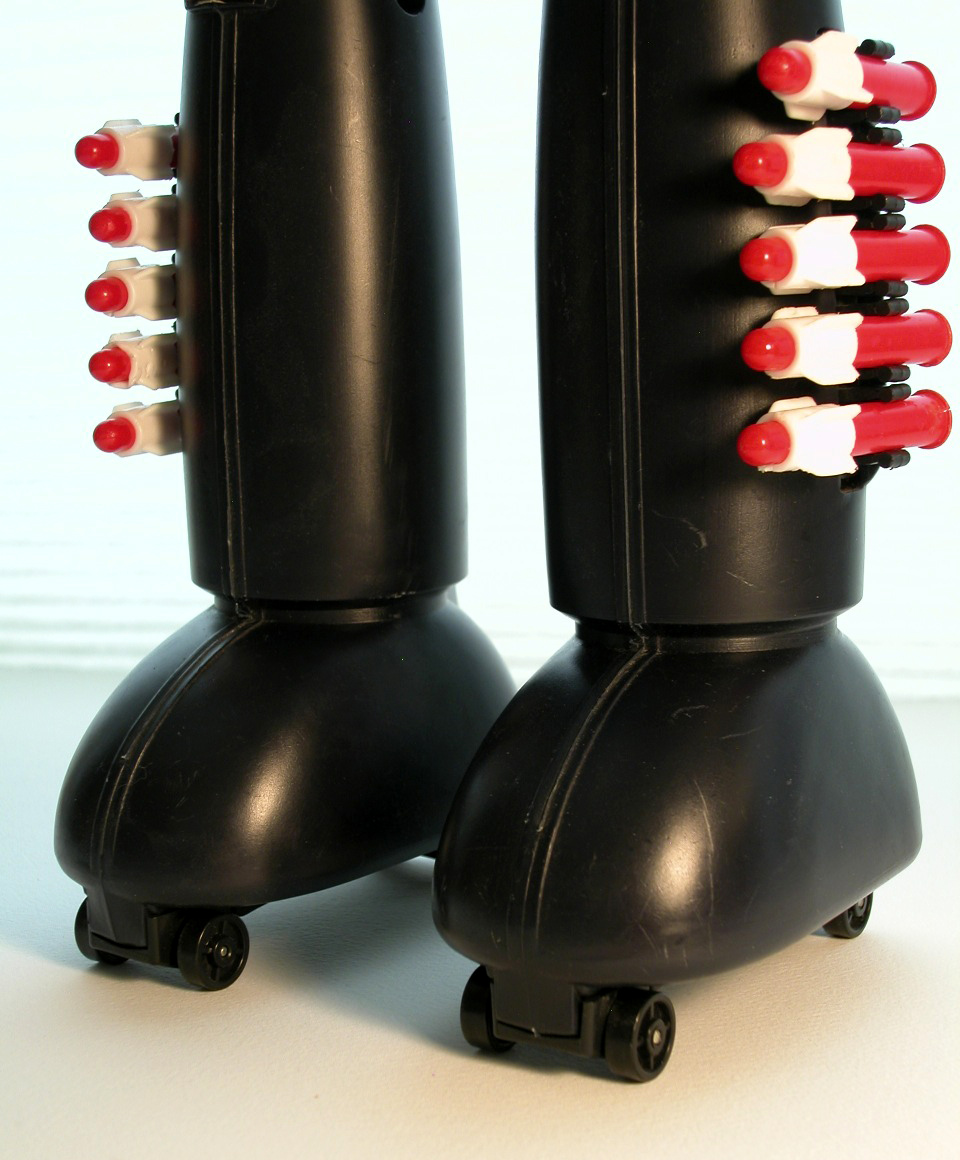
Godzilla, despite NOT being a robot still has a couple of action features.  His left fist shoots off at the press of a button (further up on his forearm) and actually packs quite a wallop.  He also has a lever on the back of his head that extends his "ugly tongue" as one 1978 COMMERCIAL puts it.  Another COMMERCIAL called it a "blast of fire."  It's basically a silk-screened piece of pliable plastic but is still a fun feature.  Other than wheels on the bottom of his feet (like all Mattel Shogun Warriors), that's about it for features.  


Interestingly enough, instead of using the superior Popy version of the same toy and importing it to the US like the other Shoguns, Mattel opted to create their own Godzilla with a much less intimidating look than his Japanese counterpart.  He's definitely a "softer" Godzilla than the Japanese toy.


 At any rate, this US version of Godzilla is a still a fantastic toy and provided hours of fun for the kids that had one.  I didn't have one as a kid but enjoyed looking at the Godzilla box on the toy store shelf.  I picked this one up last year and I'm very glad I did.  He makes a very nice addition to my growing Shogun Warriors collection.

Now, I just have to decide if he's "friend or foe."  As the commercial puts it, It's up to me to decide.


Friday, February 8, 2013

Mattel Shogun Warriors Mazinga


Mazinga!  I picked this guy up last year to add to my Shogun Warrior collection.  I lucked out and found one in pretty nice shape.  After tracking down a few original accessories, he's complete and all original.


The Shogun Warrior toys were distributed in the US by Mattel in the mid-to-late 70s.  They were created by a Japanese company, Popy, and were produced as characters from several different Japanese licenses (cartoons).  Mattel brought them over to the US with a few minor modifications and sold them under one banner and license… The Shogun Warriors.

As toys go, these Shogun Warriors were huge… around 2 feet tall.  To a kid, these things were immense.  Even as an adult, these things seem very large and Mazinga is no exception.


I didn't have a Mazinga as a kid but a friend down the street had one.  I had a Dragun but was secretly jealous of my friend's Mazinga.  Mazinga just had an intimidation factor that the other Shoguns just didn't have.  His horns, pointy head, Vader-like grill on his face, and red chest armor made him look like something not to be messed with.  He could shoot 3 rockets from his fist at the same time, or one at a time.  He even came with two swords should he run out of missiles and have to cut down his foes "Medieval Style."  If things got really dicey, Mazinga's pilot could jettison from the top of Mazinga's head in a separate craft.  How cool is that?!


My appreciation for these large Shogun Warrior toys seems to grow with age.  In the history of US toys, they were really something different and special on the toy shelves back in the 70s.  While in Japan these characters' popularity continues today with new cartoons and toys, in the US we haven't seen true Shogun warrior toys in decades.  I'd love to see Mattel or another company take the necessary steps to rerelease these guys or continue the concept with brand-new Shogun toys.  I'm sure the fact that Shoguns are actually from different Japanese licenses is a hinderance.  But, hey, they made it happen once, right?


As a kid, I was more into things like 12" Gijoe, Star Wars, and the Six Million Dollar Man.  However, in adding more Shoguns to my collection lately, I have a renewed appreciation for them…. and, Dang! do they look cool on the shelf.


Sunday, September 25, 2011

Mickey Mask 1974

This is one of the gifts I opened for Christmas last year from my Mom and Dad. Sure, it might not look like much but it's something I hadn't seen in quite a long time. This is another item that I made with my Dad when I was a kid... a Second Grader, to be more specific. I can't remember the specifics, but this paper mache mask was done for a school project. My folks kept it all these years. It's in pretty bad shape, but still very cool to see again.

When I was a kid, I was always "in" to something. In other words, I tended to fixate on television and movie characters and, most often, the toys that went with them. Among my young childhood obsessions were Disney characters like Mickey Mouse and Donald Duck. Before I discovered things like Planet of the Apes and Evel Knievel, Mickey Mouse was a character favorite of mine in the very early 1970s. I watched cartoons, drew Disney pictures, and dreamed of one day visiting Disneyland and seeing all the colorful characters, in person.

So, when the opportunity came to make a mask for a school project, Mickey was at the top of my list. I remember layering goopy, gluey newspaper strips all over a blown-up balloon to make the basic headshape and ears. Once dried, it was painted and a bent metal measuring spoon, painted black, served as the nose. At some point, Mickey's nose must have disappeared as he was sans spoon when I opened the box my parents wrapped up for me.

This is my "Mickey Collection," at the time. The ridiculousness of this photo cracks me up. Didn't I have more pressing things to do than this?! Anyway, my kid brother, Mike, was kind enough to stand-in and help me display my Mickey bounty. I'm holding a Mickey ventriloquist dummy that I got for Christmas a year or two earlier. My brother is holding a Mickey Mouse bust bank and Mickey doll, of some kind. On the wall, is a Mickey corkboard for keeping track of all the pressing things a 7 year-old would need to keep organized. I'm wearing a home-made Mickey Mouse Club shirt (don't be jealous) and an official, stylin' Mickey Mouse ears hat. A mysterious arm holds the Mickey Mask that is the subject of this post.

I still have the same Mickey bank that was one of the toys in the picture above. These two decorated my room when I was about 4 or 5 years-old and have just kind of stayed with the family, all these years. I think I adopted them, officially, into my collection of toys just a few years ago. I came across them recently when looking through boxes of toys in a recent "toy purge" to thin out my collection.

Being a good Mickey in 1974... waving to the crowd.

Another shot of my brother, Mike, and I. This seems like a lifetime ago. These days, we're all starting to get up in years, but it's always neat to have an object like this mask as a tangible reminder of the simpler, care-free days of being a child.

Sunday, September 18, 2011

Hasbro 1970 Gi Joe Adventure Team Land Adventurer

This is Hasbro's 1970 Land Adventurer from the GiJoe Adventure Team line of action figures. As I've mentioned before, with public backlash against military toys in the late 60's and early 70's, Gi Joe needed to redefine himself as an "adventurer" rather than a soldier. With newly-flocked hair and beard (vs. the beardless painted hair previous versions of Joe), the Adventure Team was ready to take on Mother Nature instead of foreign soldiers. This change from soldier to adventurer proved to be quite a success and millions of these figures found their way into countless backyard adventures everywhere.

When I was about 5 or 6 years old in the very early 70's, it seemed that every kid had an Adventure Team GiJoe or two (and maybe even a few of the 60's military figures handed down from an older brother). Like the 60's GiJoe line before, when you got your hands on an Adventure Team (AT) Gi Joe, you weren't just introduced to a world of of action figures. No, you were inducted into a huge world of possibilities that included vehicles, playsets, and other uniforms and outfits. The amount of add-ons for Joe seemed endless and it was always a thrill to visit the toy store and drool over all the adventures your Joe (or Joes) could have if only Mom and Dad would pony up the dough for new Gi Joe stuff. Your Joe could capture a wild gorilla or white tiger, dig up an old mummy, or even recover a stolen idol (Yep, ol' Joe was doing it way before Indy). Most the time, the smaller accessory sets could be purchased with some saved allowance but the bigger sets usually ended up as Christmas or birthday presents.


Although, there were five or six different figures in the Adventure Team line-up. The Land Adventurer seemed to be the "go to" guy for most missions. His visage (dark hair and beard) graced most of the add-on adventure sets' packaging. He also seemed to be the most prevalent Joe amongst neighborhood kids, for whatever reason. Mabye it was his camo outfit that attracted so many kids.

The figure in the photos is a fairly recent addition to the Yesterville archives. He's the first version of the AT Land Adventurer with the "nose picker" (affectionately named for the extended index finger on the right hand) hard hands, pistol, and shoulder holster. Later versions of the Land Adventurer would feature "Kung Fu" grip hands and a scoped rifle. Although this original style of hands made it somewhat difficult to hold guns and accessories, they have held up much better over time than their Kung-Fu counterparts. The Kung Fu hands are made of a rubber material that has dried and broken (take note Hot Toys!) on many figures, while the original hands are made of a less flexible, sturdier plastic that has survived on most figures, just fine.

One of the coolest things to me, as a kid, about the AT GiJoes was their big, chained "AT" medallions around their necks. I loved the AT graphic symbol, for whatever reason, and almost viewed it to be like a superhero logo. This was a replacement accessory for the metal dog tags that came with the earlier 60's GiJoes. During a meeting at Hasbro during the development of the AT logo, one of the employees remarked at how much the AT symbol looked like a peace symbol (which was EVERYWHERE back then... t-shirts, posters, bumper stickers, etc.). The owner of Hasbro responded by saying, "Let's hope so!!" Hasbro was eager to leave the stigma of military toys behind and any similarity to the peace symbol certainly couldnt have hurt. At any rate, there's just something I really love about these huge, over-sized medallions that is just so indicative of the early 70's.


One of the things that many younger action figure collectors are surprised by when they first hold and pose a vintage 12" GiJoe is just how well-articulated and posable they really are. I'm always a little shocked by this since GiJoe was the very first boys' articulated action figure and the development guys at Hasbro really did their homework and came up with an amazing base body for their new toy. In my circle of (older) friends, it's been pretty much common-knowledge that action figures started on a high point and had begun to de-evolve (articulation-wise), in the late Seventies with the onset of small 5-point articulated figures. Many younger collectors grew up in the 80's and 90's when action figures were smaller, simpler, and much, much less articulated than their predecessors like GiJoes and Megos. As more and more companies have started putting more and more articulation into their smaller all-plastic figures, many believe this to be a new development in the world of action figures. That's my guess as to why the "disconnect" happens, anyway.

The Adventure Team Land Adventurer was many kids' very first action figure. He predates even the first Mego Superhero figures by several years and the smaller 3 3/4 Joes by over a decade. He truly is a prime example of a much simpler time in the world of action figures. I can hardly believe he's over 40 years old this year. Someone put a brake on these years... they are rolling by much too fast.

Saturday, September 17, 2011

Ideal Evel Knievel Silver Hi-Jumper

This is the Ideal Evel Knievel Silver Hi-Jumper cycle from 1977. This is one of the most rare Evel Knievel toys ever produced. In 1977, Knievel had a controversial parking lot altercation with a writer that slandered him in a "tell-all" book. The writer left the incident with two broken arms and Evel was left facing jail time. Rather than continue to produce toys that used the Knievel name, Ideal Toys chose to end their relationship with Evel rather than risk losing money on a toy line associated with the then-maligned Knievel name.
Consequently, some Knievel toys did not make it to production or were canceled not far into production. The Silver Hi-Jumper set was one that ended up having very low production numbers. Information online is sketchy but it seems that somewhere between 1000 and 1500 of these sets made it to toy shelves before the final curtain closed on Ideal's mighty and lucrative Evel Knievel toy line.


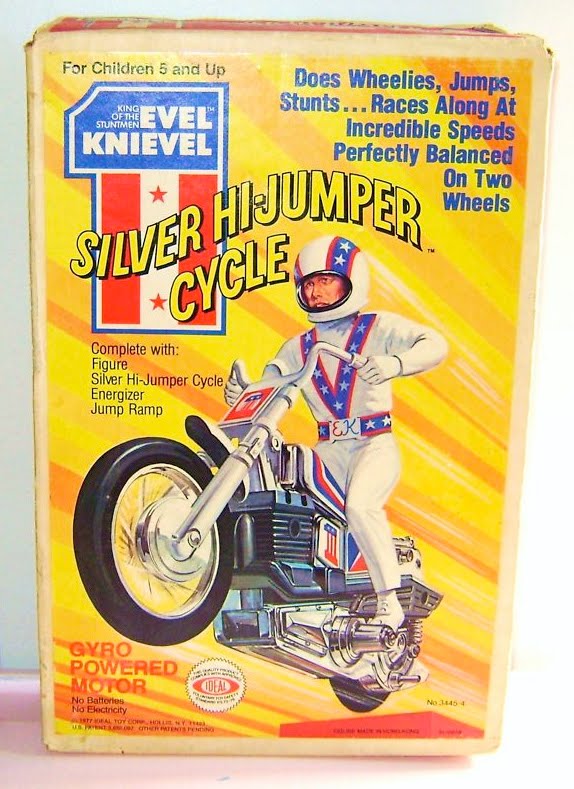
The full-set included the Silver Hi-Jumper cycle, Energizer (winder), a white-suited Evel Knievel figure with helmet, and a red ramp. If I'm not mistaken, this was the only vintage Knievel cycle set to come with a jumping ramp in the box. Other sets like the Scramble Van and the Stunt Stadium (both forthcoming in reviews) included ramps but not a cycle.

This particular Silver Hi-Jumper pictured was acquired by me about a year ago. It's missing some silver paint here and there but is in nice condition, otherwise. It runs and nothing is broken. A blue-suited Evel figure is standing in for the white one that would have originally come with this set.

The cycle itself is actually a repaint of a much more common Knievel toy cycle called the Trail Bike. The Trail Bike body was black plastic with chromed engine and tail pipes but the Silver Hi-Jumper is painted in reverse with an all-chrome finish and black engine and tail pipes. Although, the distinction between the two bikes is somewhat minimal, the rarity of the silver bike makes it one of the line's "holy grails."

I didn't have this cycle as a kid. In fact, I had never heard of it until more recently when researching the line of Evel Knievel toys. However, I came across this example for a screaming deal and had to pick it up. I was very glad to add it to the collection of Knievel toys I've gathered over the years.


This is the box that the Silver Hi-Jumper cycle set was sold in. I love these old illustrated, no-window toy boxes.

Every year, we make a few trips to Evel's hometown of Butte, Montana for some of my boys' soccer games. Last year, we stopped at Evel's grave to see his final resting place and pay our respects. Evel was one of my biggest heroes as a kid and it felt pretty neat to be able to walk right up and visit the grave of such a famous and iconic American.

The backside of Knievel's grave was inscribed many years ago. Evel intended that this stone be erected as a commemoration of his attempt to jump the Snake River Canyon in 1974. When that didn't pan out, the stone was put into storage. Later in life, as Evel struggled with illness, he pulled the stone out of storage and had it transported to Butte to be used as his headstone.